From 1899 to Now: How Songwriter Contracts Have Evolved
When we talk about iconic pieces of American music, Maple Leaf Rag by Scott Joplin almost always comes up. But beyond its musical influence, the story behind its publishing deal also says a lot about how songwriter contracts used to work—and how much they’ve changed since 1899.
As a Music Business student concentrating in recorded music and publishing, I wanted to revisit Joplin’s original agreement and compare it to the kind of deal an emerging songwriter might face today. Even though more than a century has passed, the basic power dynamics between writers and publishers are surprisingly familiar.
1. The 1899 Deal: Simple, Harsh, and Very Old-School
Back in 1899, Joplin had a great song but no resources to publish it himself. Publisher John Stark stepped in, bought the copyright for just $50, and took full control of Maple Leaf Rag. Stark paid for plates, printing, and distribution, and in return, he owned 100% of the copyright.
Joplin’s compensation was straightforward:
1 cent per printed copy sold
10 free copies
the option to buy additional copies wholesale for 5¢
and that’s… basically it
No advance, no reversion clause, no term limit, and no split like the 50/50 deals we see today. If anything, this contract is an early prototype of a single-song traditional publishing deal, just far less generous.
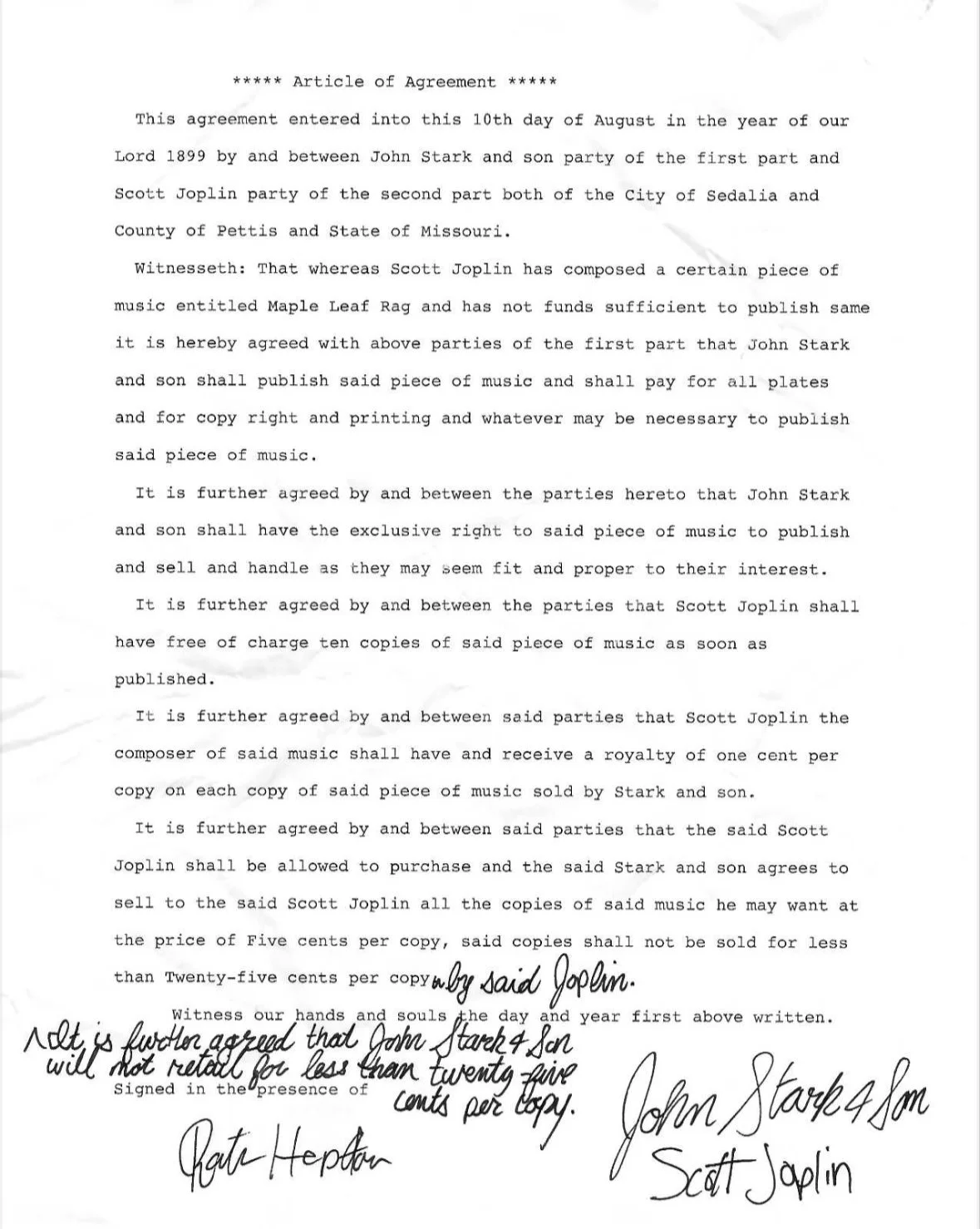
2. Breaking Down the Terms in Today’s Language
If we translate the 1899 contract into the way we talk about deals now, it would look like this:
Grant of Rights: Publisher owns everything
Exclusivity: Applies to Maple Leaf Rag only
Term: Not stated → likely perpetual
Royalties: Flat rate per printed copy
Advances / Delivery / Reversion: Not included
Territory: Not specified
It’s simple because publishing itself was simple at the time. No streaming, no sync, no PROs, no global licensing systems—just sheet music sales.
3. What Would the Modern Version of This Deal Look Like?
If a “modern Joplin” showed up today with one promising song, they’d probably be an independent songwriter with no previous cuts or hits. A modern version of Stark would likely be a small indie publisher—the kind that takes risks on early-stage talent.
The most realistic deal?
Single-Song Traditional Deal
And here’s what would change:
✔ Term
Modern deals always include a defined contract period, commonly 3–5 years.
✔ Royalties
Instead of 1 cent per printed copy, revenue today comes from:
performance royalties
mechanical royalties
sync licensing
digital sources
The publisher keeps the publisher’s share, and the songwriter keeps the writer’s share (50%).
✔ Advances
Very new writers often get no advance, or something symbolic (like $300–$1,000). Definitely nothing like a large co-publishing advance.
✔ Territory
Standard today: Worldwide or even Universe.
✔ Reversion
Some indie publishers might include a reversion clause, but usually not a generous one for beginners.
Even after all this time, one thing hasn’t changed: new writers rarely have leverage. Publishers invest time and risk, so they negotiate from a stronger position.
4. What Today’s Songwriters Can Learn from Joplin’s Deal
Even though the industry has advanced dramatically, the structure of publishing deals still reflects the same core ideas:
Leverage matters more than talent.
Joplin believed in his own success but still couldn’t negotiate better terms.Copyright knowledge is essential.
He signed away his rights permanently—today’s writers should understand what they’re giving up.Publishing is still a business of risk and reward.
Publishers take financial risk and want control in return.A single song can change everything—but only with the right deal.
Maple Leaf Rag became huge, but Joplin’s contract didn’t reflect that success.
